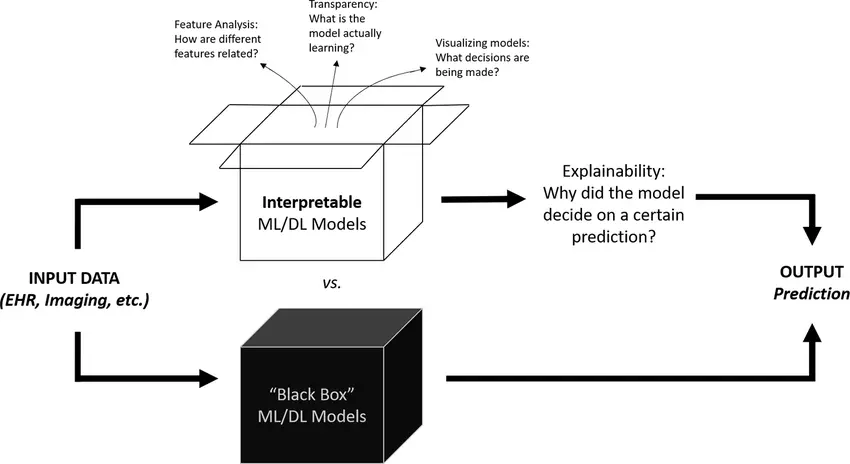

The rapid deployment of deep learning systems across the global economy has yielded unprecedented predictive accuracy. Deep neural networks now outperform humans in specialized image recognition tasks, predict macromolecular structures with atomic precision, and process multi-modal data streams to automate financial markets. Yet, this leap in capability has introduced a critical systemic risk: the “Black Box” problem.
As machine learning models grow in parameter scale—often utilizing billions of weights across hundreds of hidden layers—their internal decision-making logic becomes entirely opaque to human engineers.
In low-stakes environments, such as streaming-platform recommendation engines or digital advertising placement, this opacity is an acceptable trade-off for high performance. However, as these systems migrate into safety-critical and highly regulated domains—including automated clinical diagnostics, algorithmic credit lending, criminal recidivism risk assessment, and autonomous defense systems—the inability to answer why a model reached a specific conclusion becomes a legal, ethical, and operational bottleneck.
Explainable AI (XAI) represents the suite of frameworks, mathematical techniques, and architectural designs engineered to resolve this tension, transforming opaque mathematical constructs into interpretable, auditable systems.