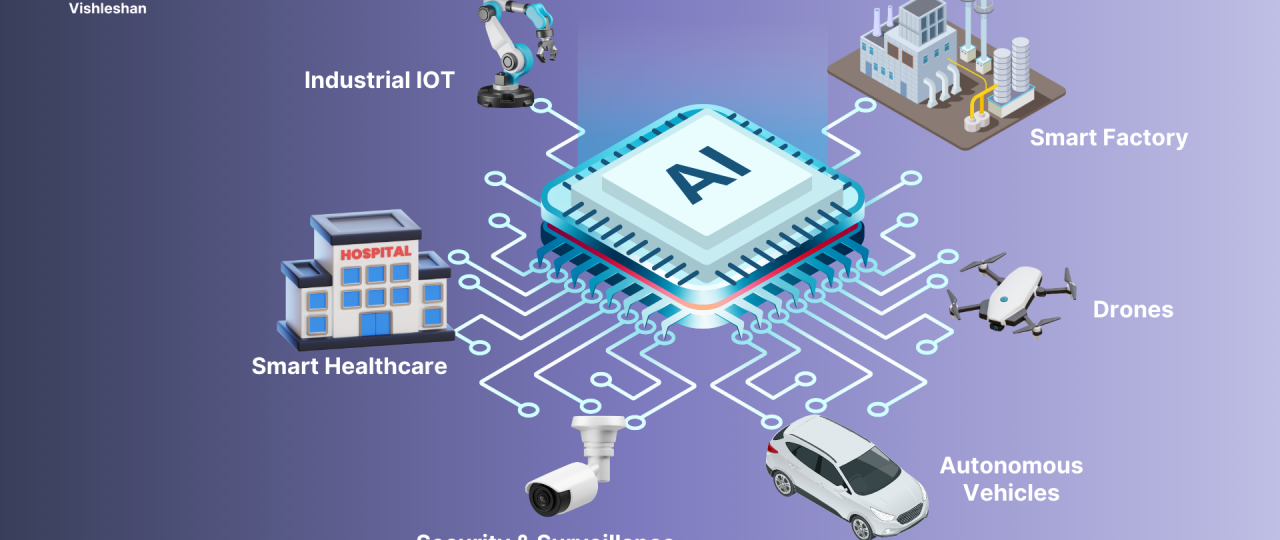

For the past decade, the default architecture for artificial intelligence deployment has been centralized cloud computing. Sensor data collected at the periphery of networks is packaged, transmitted over telecommunications infrastructure, processed inside hyper-scale data centers, and returned to the device as an actionable command.
However, as the Internet of Things (IoT) expands toward billions of active nodes, this architecture faces three hard physical limits: latency bottlenecks, bandwidth saturation, and intermittent connectivity. Edge Intelligence (or Edge AI) represents the architectural migration of model execution and training away from centralized cloud servers directly onto localized hardware nodes operating at the network perimeter.
[ Central Cloud Data Center ]  ◄─── (High Bandwidth / Heavy Compute)
             │
             ▼  (Model Deployment via Quantization)
┌────────────────────────────────────────────────────────┐
│                  EDGE INTELLIGENCE LAYER               │
│  [Smart Cameras]    [Medical Devices]   [Robotic Arms] │
└────────────────────────────────────────────────────────┘
             ▲
             │  (Sub-millisecond Local Inference Loop)
[ Physical Environment Sensors ]
The Engineering Challenges of Constrained Environments
Deploying deep neural networks onto edge devices—such as microcontrollers, smart surveillance systems, or wearable biometric monitors—requires working within extreme physical hardware constraints:
- Compute Limitations: Edge chips often operate with limited processing power compared to data-center cluster GPUs.
- Memory Allocations: Microcontrollers may have less than 256 KB of RAM and low flash storage capacity.
- Thermal and Power Budgets: Industrial sensors or remote IoT arrays frequently run on batteries or harvest local energy, requiring them to operate within strict milliwatt power envelopes.
Because standard deep learning architectures require gigabytes of memory and trillions of floating-point operations per second (FLOPS), they cannot run on edge hardware without systematic optimization.
Model Compression and Optimization Methodologies
To bypass these hardware limitations, the field of Edge AI relies heavily on four mathematical optimization techniques:
- Quantization: Standard neural networks store weights as 32-bit floating-point numbers (FP32). Quantization reduces the bit-width of these weights to lower precision formats, such as 16-bit floats (FP16) or 8-bit integers (INT8). Converting an FP32 network to INT8 reduces the model’s storage footprint by up to 75% and shifts execution from slow floating-point units to highly efficient integer math hardware, with minimal loss in model accuracy.
- Pruning: Neural networks are typically overparameterized; many weights are close to zero and contribute little to the final inference. Pruning algorithms analyze the network’s weight matrices, identify low-impact connections or entire neural channels, and eliminate them. This creates sparse matrices that require fewer computations and smaller memory footprints.
- Knowledge Distillation: This technique trains a small, compact “Student” network to mimic the behavior and output distribution of a massive, pre-trained “Teacher” network. The student model learns to replicate the soft probabilities generated by the teacher, capturing complex structural knowledge while running on a fraction of the computational budget.
- Hardware-Accelerated Silicons: Edge AI is supported by a new class of specialized hardware, including Edge TPUs (Tensor Processing Units), Neural Processing Units (NPUs), and low-power Neuromorphic chips that execute matrix math natively in hardware at the milliwatt scale.
Real-World Use Cases and Impact
- Time-Critical Industrial Automation: In smart manufacturing, an automated robotic arm cannot afford a 100-millisecond latency round-trip to the cloud when identifying a structural fault on an assembly line. Localized anomaly detection models running on edge processors can trigger safety cutoffs within sub-millisecond timelines.
- Remote Smart Grids: Infrastructure installations—such as wind turbine arrays in remote maritime locations or pipeline sensors in desert landscapes—frequently operate with zero cloud connectivity. Edge intelligence allows these machines to perform onboard diagnostics, process environmental data, and adjust operations autonomously.
- Consumer Privacy and Wearables: Health monitors that analyze electrocardiogram (ECG) data locally on the user’s wrist eliminate the security risk of transmitting raw biometric information across public networks, keeping health diagnostics local and secure.